NICU Services in Pokhara: Premature and Sick Newborn Care at A&B Hospital
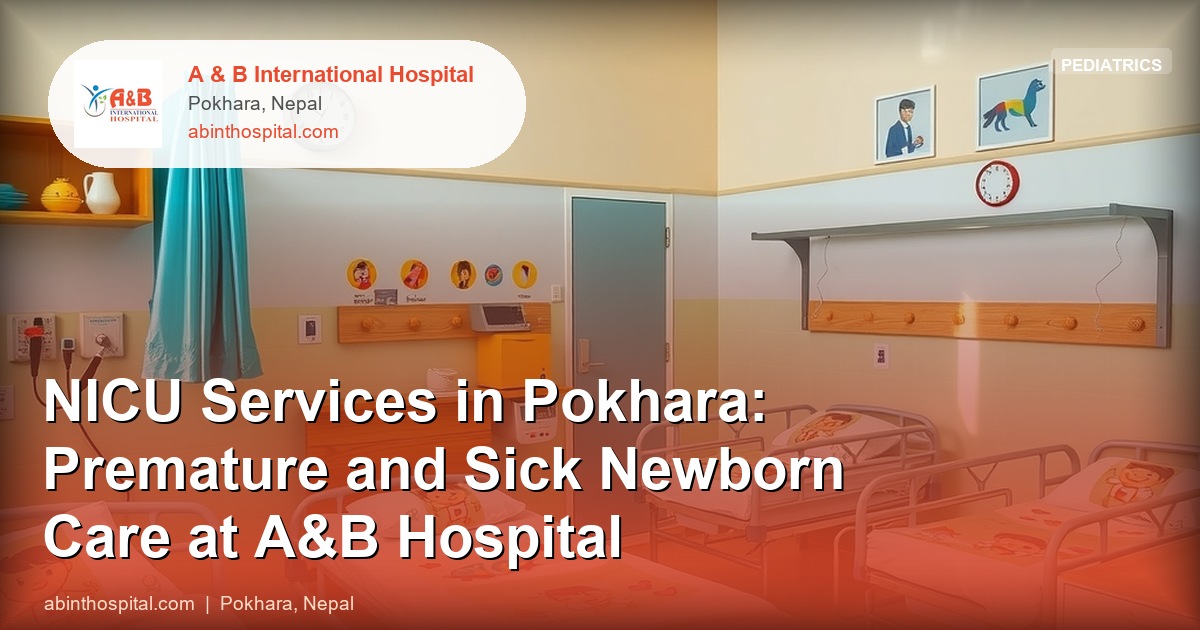
The neonatal intensive care unit (NICU) bridges the gap between birth and the moment a baby is stable enough to go home. For families in Pokhara and the Gandaki region, A&B International Hospital’s NICU provides the specialized monitoring, equipment, and skilled nursing that premature and sick newborns require during the most vulnerable weeks of their lives.
What Is a NICU and What Happens There?
A NICU (Neonatal Intensive Care Unit) is a specialized hospital unit equipped to care for newborns who are too premature, too small, or too ill to remain in the general maternity ward. It provides incubator warmth, oxygen support, intravenous nutrition, monitoring of vital signs, and medical treatment for newborn-specific conditions.
The NICU at A&B International Hospital is staffed by neonatology-trained physicians and specialized neonatal nurses who manage babies 24 hours a day. Monitoring includes continuous pulse oximetry, cardiac monitoring, temperature regulation, and regular blood glucose and bilirubin measurement.
Which Newborns Need NICU Care?
Most newborns are healthy and go home with their mothers within 24–72 hours of delivery. NICU admission is needed when a baby is medically unstable or has a condition requiring monitoring or treatment that cannot be safely provided in the general nursery.
Conditions requiring NICU admission:
Prematurity
- Any baby born before 37 weeks gestation may require NICU monitoring. Those born before 32 weeks almost invariably need intensive care.
- Premature babies have underdeveloped lungs (respiratory distress syndrome), difficulty maintaining body temperature, poor feeding reflexes, and immature immune systems.
Low birth weight
- Birth weight below 2,500 grams (low birth weight, LBW) and especially below 1,500 grams (very low birth weight, VLBW) requires neonatal monitoring.
- These babies are at risk of hypothermia, hypoglycemia, infection, and feeding difficulties.
Breathing problems
- Respiratory distress syndrome (RDS) in premature babies due to surfactant deficiency.
- Transient tachypnea of the newborn (TTN) — wet lungs after Caesarean delivery.
- Meconium aspiration syndrome — from breathing in meconium-stained amniotic fluid at delivery.
- Congenital pneumonia.
Neonatal jaundice requiring phototherapy
- Bilirubin above the treatment threshold for the baby’s age (in hours) and weight requires phototherapy (light treatment).
- Severe jaundice not responding to phototherapy may require exchange transfusion.
Neonatal infection (sepsis)
- Fever or low temperature in a newborn, with lethargy, poor feeding, or respiratory distress, requires investigation for bacterial sepsis and IV antibiotic treatment.
Birth asphyxia
- Babies who did not breathe or had a low heart rate at delivery require close monitoring, cooling therapy in severe cases, and support for organ systems affected by oxygen deprivation.
Congenital abnormalities
- Cleft palate, cardiac defects, or other structural abnormalities may require NICU stabilization prior to surgical evaluation or transfer.
What Equipment and Treatments Are Used in the NICU?
Incubators and warmers: Premature and low birth weight babies cannot maintain their own body temperature. Closed incubators provide a humidified, temperature-controlled environment. Radiant warmers are used for procedures and for larger babies needing observation.
Oxygen therapy: Supplemental oxygen is delivered via nasal cannula, high-flow nasal cannula, CPAP (continuous positive airway pressure), or mechanical ventilation depending on severity.
Intravenous feeding (parenteral nutrition): Very premature babies cannot absorb enteral feeds initially. Glucose, amino acids, and lipids are delivered intravenously through an umbilical venous catheter (UVC) or peripheral IV.
Phototherapy: Blue spectrum fluorescent lights placed above and below the baby reduce bilirubin levels. Eyes are shielded. Double phototherapy (lights above and below) is more effective for severe jaundice.
Blood glucose monitoring: Premature and SGA (small for gestational age) babies are prone to hypoglycemia. Blood glucose is checked every 2–4 hours until feeds are established and stable.
Antibiotics: Broad-spectrum IV antibiotics are started empirically when neonatal sepsis is suspected, narrowed based on blood culture results.
What Is the Role of Parents in the NICU?
Parents are not passive bystanders in the NICU — they are essential members of the care team. Research consistently shows that increased parental involvement in NICU care improves neurodevelopmental outcomes, promotes breastfeeding, and reduces parental anxiety.
How parents participate:
- Skin-to-skin (kangaroo mother care): The single most effective non-medical intervention in NICU care. Holding the baby against the parent’s bare chest stabilizes temperature, heart rate, breathing, and oxygen levels, promotes bonding, and increases breast milk production.
- Expressed breast milk: Mothers are encouraged to begin expressing breast milk from the first hours after delivery, even before the baby can take oral feeds. NICU nursing staff support mothers with pump access and technique guidance.
- Nappy changes and mouth care: Parents perform basic care tasks under nursing supervision from early in the NICU stay.
- Decision-making: Parents are consulted on and consent to all significant treatment decisions.
Open visiting policies allow parents to be present in the NICU during the day. Specific procedures may require parents to step out briefly. Siblings should be healthy (no colds or infections) before visiting.
What Is Kangaroo Mother Care?
Kangaroo mother care (KMC) involves holding the premature or low birth weight baby in continuous skin-to-skin contact — the baby dressed only in a nappy and hat, placed upright against the parent’s bare chest, covered with the parent’s clothing.
WHO evidence endorses KMC as potentially life-saving for babies weighing less than 2,000 grams. Benefits include:
- Stabilization of temperature (mother’s skin temperature regulates baby’s temperature)
- Reduction in apnea episodes (stopping breathing)
- Faster weight gain
- Improved breastfeeding rates
- Earlier hospital discharge
- Lower rates of hospital-acquired infection
KMC can be practiced by fathers as well as mothers. Both parents are taught KMC technique by NICU nursing staff.
How Long Does a Baby Stay in NICU?
Length of stay depends entirely on the condition and gestational age at birth. There is no standard timeline.
Approximate NICU stay durations by condition:
- Jaundice requiring phototherapy: 1–5 days
- Mild respiratory distress (TTN): 2–7 days
- Neonatal sepsis: 7–14 days minimum (course of antibiotics)
- Premature baby at 34–36 weeks: Days to 2 weeks
- Premature baby at 30–33 weeks: 4–8 weeks typically
- Very premature baby under 30 weeks: Up to the original due date
The rule of thumb for discharge planning in premature babies is: most are ready for home around their original due date (40 weeks corrected gestational age), provided they meet the criteria below.
What Are the Discharge Criteria From the NICU?
Discharge from NICU requires all of the following to be met:
- Stable, self-regulated body temperature in an open cot (no incubator) for at least 24–48 hours
- Taking full oral feeds (breast or bottle) without supplemental tube feeding
- No apnea episodes for 5–7 days off caffeine (if caffeine was used)
- Oxygen saturation above 94% on room air consistently
- Weight gaining consistently (minimum 15–20 g/kg/day)
- Parents trained in basic newborn care, feeding, and danger sign recognition
- Follow-up appointment scheduled
What Follow-Up Does a Baby Need After NICU Discharge?
NICU graduates require closer follow-up than term healthy newborns. First follow-up appointment at A&B within 48–72 hours of discharge checks weight, feeding, temperature, and jaundice.
Subsequent follow-up schedule for premature and NICU babies:
- Ophthalmology screening (retinopathy of prematurity) for babies born before 32 weeks or under 1,500 grams
- Hearing screening (BERA/ABR) — infection, asphyxia, and jaundice all increase hearing loss risk
- Developmental follow-up monitoring milestones using corrected age (subtract weeks of prematurity from chronological age)
- Immunization using actual birth date, not corrected age
NICU Care for Your Newborn at A&B International Hospital, Pokhara
A&B International Hospital
Pokhara-02, Bindhyaabasini Way to Sarangkot
Phone: +977 061-412512
Website: abinthospital.com
Specialized neonatal care for premature and sick newborns. ECHS empanelled. Parents involved at every step. Call our team for any neonatal concern — day or night.