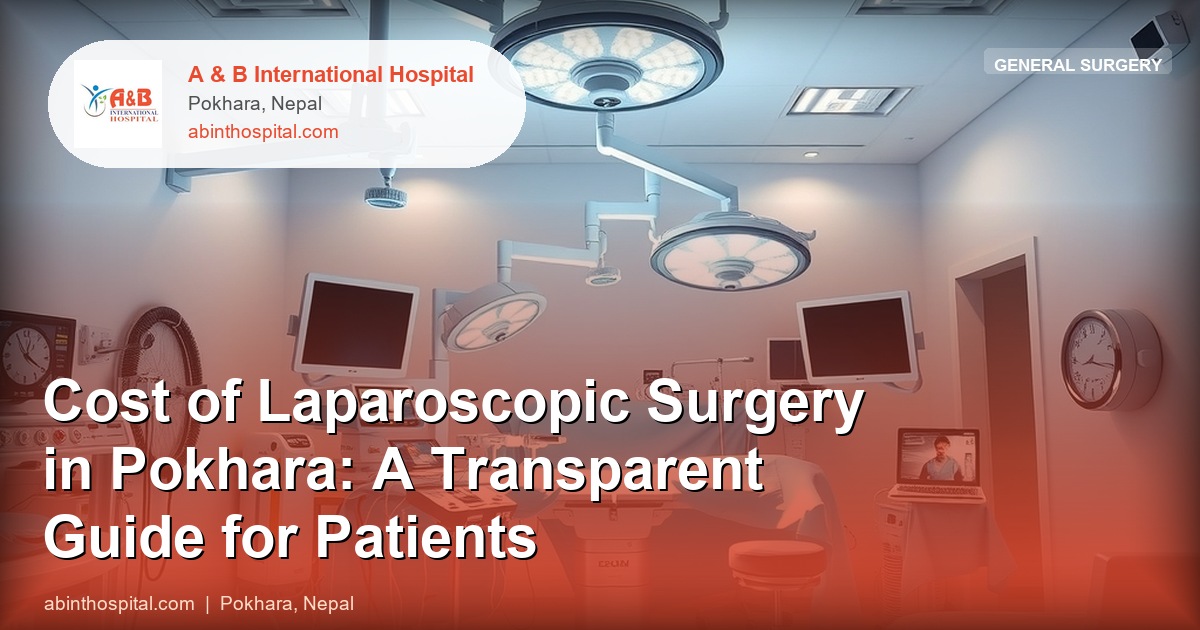
Cost of Laparoscopic Surgery in Pokhara: A Transparent Guide for Patients
Surgery is a significant financial event for most Nepali families. Lack of transparent pricing information often drives patients to delay surgery, travel to distant cities under the assumption of lower cost elsewhere, or make uninformed decisions about care quality. This guide breaks down what you are paying for, what influences cost, and how patients in Pokhara can access surgical care more affordably.
What Are the Main Cost Components of Laparoscopic Surgery?
The total cost of laparoscopic surgery at any hospital is made up of several distinct components. Understanding what is included in a quoted price — and what may be charged additionally — prevents unexpected bills.
Surgeon’s fee: Covers the operating surgeon and, for laparoscopic procedures, often a surgical assistant. This is quoted separately or bundled into a package price depending on hospital billing structure.
Anesthesiologist’s fee: Laparoscopic surgery requires general anesthesia. The anesthesiologist manages induction, maintenance, emergence, and post-anesthesia recovery. This is a separate professional fee.
Operating theatre charges: Covers theatre time (typically billed per hour or per procedure), theatre consumables (drapes, gowns, sterile supplies), instrument set use, and laparoscopic equipment use (camera system, insufflator, light source).
Disposable surgical instruments and implants: Laparoscopic surgery uses single-use items including trocars, cannulas, retrieval bags, clip appliers, energy devices (harmonic scalpel or LigaSure), and — for hernia surgery — mesh. These per-procedure consumable costs differ from hospital to hospital.
Hospital stay: Room charges per night (general ward, semi-private, or private room), nursing care, food, and ward consumables.
Pre-operative investigations: Ultrasound, blood tests, chest X-ray, ECG. These may be performed at the hospital or at an external diagnostic center.
Post-operative medications: Analgesics, anti-nausea drugs, antibiotics, and dressings prescribed on discharge.
What Are the Approximate Procedure Costs for Common Laparoscopic Surgeries in Pokhara?
Surgical prices vary between hospitals and are influenced by room category, complexity, and implant requirements. The ranges below reflect typical all-inclusive package costs (surgeon + anaesthesia + theatre + 1–2 nights stay + basic medications) at a private hospital in Pokhara.
Laparoscopic cholecystectomy (gallbladder removal):
- Uncomplicated, elective: NPR 55,000–90,000
- With acute cholecystitis (longer stay, IV antibiotics): NPR 80,000–130,000
Laparoscopic inguinal hernia repair (unilateral, with mesh):
- Uncomplicated: NPR 65,000–110,000
- Bilateral (both sides, same surgery): NPR 90,000–140,000
Laparoscopic appendectomy:
- Uncomplicated, early appendicitis: NPR 55,000–85,000
- Perforated appendicitis (longer stay, IV antibiotics): NPR 100,000–160,000
Laparoscopic diagnostic laparoscopy:
- NPR 35,000–60,000 (excludes additional interventions if performed)
Piles surgery (open hemorrhoidectomy):
- NPR 35,000–65,000
Thyroid surgery (partial or total thyroidectomy):
- NPR 80,000–150,000 depending on extent
These are indicative ranges and are subject to change. Contact A&B International Hospital for a current package quote specific to your condition.
How Does Pokhara Compare to Kathmandu for Laparoscopic Surgery Costs?
Surgery at a comparable quality private hospital in Kathmandu typically costs 25–50% more than the same procedure in Pokhara. This price difference stems from:
- Higher real estate and operational costs in Kathmandu
- Higher consultant fees reflecting Kathmandu’s higher cost of living
- Greater competition in Pokhara driving more competitive pricing
However, comparing price without considering quality is a mistake. The critical factors to compare are:
- Surgeon’s training and documented volume of the specific procedure
- Equipment quality (HD laparoscopic systems vs older equipment)
- Anesthesia infrastructure
- ICU availability if complications arise
- Post-operative care quality
Traveling to Kathmandu also incurs transport, accommodation, and time-off costs that should be factored into the total financial calculation.
What Affects the Cost of Laparoscopic Surgery?
Procedure complexity: An uncomplicated elective laparoscopic cholecystectomy takes 30–45 minutes and has a predictable cost. An emergency cholecystectomy for complicated acute cholecystitis with gangrenous gallbladder, bile leak, and a 4-day stay is a significantly different financial situation.
Conversion to open surgery: If a laparoscopic procedure must be converted to open, theatre time, recovery time, and hospital stay increase substantially.
Implants: Hernia mesh, titanium clips, and energy device tips are individual-use, sterile items. The cost of high-quality mesh implants in hernia repair can constitute a significant portion of total cost.
ICU admission: If post-operative monitoring in ICU is required, this adds NPR 5,000–15,000 per day to the total cost.
Length of stay extensions: Complications including wound infection, bile leak, post-operative ileus, or poor pain control extend hospital stay and add cost.
Room category: Private rooms cost more than general ward beds. The surgical outcome is identical regardless of room category.
Can ECHS Patients Get Laparoscopic Surgery Cashless at A&B?
Yes. A&B International Hospital is ECHS empanelled, and eligible ex-servicemen and their covered dependants can access laparoscopic and general surgery under the ECHS cashless system where the procedure is covered under scheme rules.
Process for ECHS patients:
- Attend surgical consultation with ECHS card and service documents.
- For elective surgery, obtain ECHS pre-authorization through the hospital’s ECHS desk.
- For emergency surgery, ECHS processing occurs after stabilization — present ECHS card to the desk as soon as practically possible.
- Confirm mesh and implant coverage limits before hernia surgery, as some items have defined reimbursement ceilings.
Patients with ECHS coverage are advised to register at the ECHS desk on arrival for any consultation, not just surgical cases.
How Should Patients Plan Financially for Surgery?
Get an itemized quote before surgery. Ask for a written breakdown including surgeon fee, anaesthesia, theatre, estimated stay, pre-op investigations, and post-op medications. Compare this to any insurance benefit limit.
Understand what is not included. Blood bank charges, ICU stay, additional specialists’ fees if complications arise, and pharmacy charges for take-home medications are often listed separately.
Consider surgery insurance. Nepal’s health insurance products including the government Rashtriya Swasthya Bima Yojana (RSBY) may cover some surgical costs. Private health insurance with surgical cover provides more comprehensive protection.
Do not delay necessary surgery for cost reasons without medical advice. A straightforward elective appendectomy is less expensive than an emergency operation for a perforated appendix. An uncomplicated hernia repair costs a fraction of emergency surgery for strangulated hernia with bowel resection.
Get a Transparent Surgical Cost Quote in Pokhara
A&B International Hospital
Pokhara-02, Bindhyaabasini Way to Sarangkot
Phone: +977 061-412512
Website: abinthospital.com
We provide itemized cost estimates before every elective procedure. ECHS cashless processing on site. Call us to discuss your surgical needs and receive an honest, upfront cost estimate.