Dementia and Alzheimer’s: A Guide for Families in Pokhara
Dementia is not a normal part of aging. It is a syndrome of progressive cognitive decline severe enough to interfere with daily functioning, and it represents one of the most challenging long-term conditions that families in Nepal — where home-based family care is the norm — will face. Understanding dementia accurately, rather than attributing it to “just getting old,” enables earlier diagnosis, safer home environments, better planning, and access to whatever management can improve quality of life for both the patient and the family.
What Is the Difference Between Dementia and Normal Aging?
Normal aging produces some slowing of information processing and occasional forgetfulness — misplacing items, briefly forgetting a name, needing longer to learn new technology. These changes do not impair daily function and do not progress to disability.
Dementia involves memory and cognitive impairment that progressively interferes with daily life: being unable to manage finances, getting lost on familiar routes, failing to recognise family members, forgetting to eat or take medication, or being unable to follow a conversation. The key distinction is functional impairment — the person’s ability to manage their day is affected.
Mild cognitive impairment (MCI) is an intermediate state between normal aging and dementia: cognitive changes that are measurable on testing and reported by the patient or family, but that have not yet substantially impaired daily function. MCI carries a higher risk of progressing to dementia and warrants monitoring and cardiovascular risk factor control.
What Is the Difference Between Alzheimer’s Disease and Vascular Dementia?
Alzheimer’s disease is the most common cause of dementia worldwide, accounting for approximately 60–70% of cases. It involves the abnormal accumulation of amyloid plaques and tau tangles in the brain, causing progressive neuronal loss. The earliest and most characteristic symptom is episodic memory loss — the patient repeatedly asks the same questions, cannot remember recent conversations or events, and loses track of dates and recent occurrences. Language difficulty, spatial disorientation, and executive dysfunction follow. The course is gradually progressive.
Vascular dementia is caused by cerebrovascular disease — strokes, small vessel disease, and chronic reduced blood flow to the brain. It is the second most common dementia type and is particularly prevalent in populations with poorly controlled hypertension. This is clinically relevant in Pokhara, where hypertension is common among older adults and veterans.
Vascular dementia may have a stepwise course (sudden deterioration following a stroke, then partial recovery, then further decline with the next vascular event) rather than the gradual slope of Alzheimer’s. It often presents with executive dysfunction, slowed processing, and mood changes rather than pure memory loss.
Many patients have mixed dementia — features of both Alzheimer’s and vascular disease.
What Are the Early Warning Signs of Dementia?
Ten warning signs are commonly described. Memory loss that disrupts daily life (not just occasionally forgetting things). Difficulty with planning or solving problems. Trouble completing familiar tasks (cooking a meal, operating a phone). Confusion with time or place. Trouble understanding visual or spatial information. New problems with words in speaking or writing. Misplacing things and being unable to retrace steps. Decreased or poor judgment — making financial decisions that are unusual or risky. Withdrawal from work or social activities. Changes in mood and personality — increased suspicion, depression, anxiety, or agitation.
In Nepal, families often normalise these symptoms for years before seeking medical help. The phrase “they’re just old” delays diagnosis and the opportunity to address modifiable factors and plan ahead.
How Is Dementia Diagnosed at A&B International Hospital?
Diagnosis begins with a detailed clinical history from both the patient and an informant who knows them well — typically a family member. The history establishes the pattern and timeline of cognitive change, the domains affected, and the functional impact.
Cognitive assessment using standardised tools — the Mini-Mental State Examination (MMSE) or the Montreal Cognitive Assessment (MoCA) — provides a baseline quantitative measurement that can be tracked over time.
Blood investigations exclude treatable causes of cognitive decline: thyroid dysfunction (hypothyroidism can mimic dementia and is fully reversible when treated), B12 deficiency, syphilis, HIV, and metabolic abnormalities.
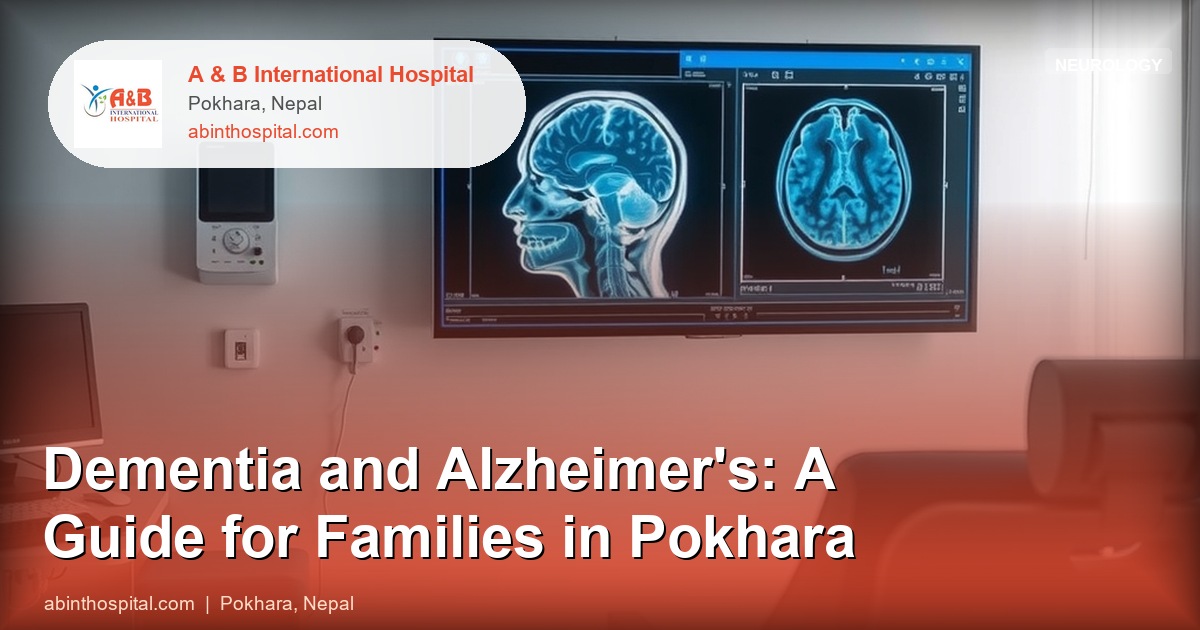
CT or MRI imaging identifies structural causes (tumour, hydrocephalus, large strokes), characterises the pattern of atrophy, and assesses white matter changes indicative of vascular disease. CT is adequate for initial dementia workup. MRI provides more detail and is preferred when available.
Is There a Cure for Dementia and What Can Be Done?
There is currently no cure for Alzheimer’s disease or most other causes of dementia. Several disease-modifying drugs targeting amyloid are in late-stage clinical trials, but their availability in Nepal is not yet relevant. However, the absence of a cure does not mean nothing can be done.
Cholinesterase inhibitors (donepezil, rivastigmine, galantamine) modestly but measurably slow cognitive and functional decline in Alzheimer’s and are recommended for mild to moderate disease. Memantine is used for moderate to severe disease, either alone or in combination. These drugs do not reverse dementia but reduce the rate of decline.
Cardiovascular risk factor control — managing blood pressure, blood glucose, cholesterol, and stopping smoking — is the most effective intervention available for vascular dementia. Every stroke that does not happen is vascular cognitive impairment that does not occur.
Non-pharmacological management is equally important: structured daily routine, cognitive stimulation (familiar activities, conversation, reading), physical exercise, good nutrition, sensory correction (glasses and hearing aids if needed), and treatment of any coexisting depression or anxiety.
How Should Caregivers Communicate With a Person Who Has Dementia?
Use short, simple sentences. Ask one question at a time and allow time for a response. Do not argue when the person says something incorrect — validate their feelings instead of correcting the fact. Do not quiz them on things they have forgotten; this causes distress without benefit.
Maintain a predictable daily routine. Changes in environment, routine, or caregiver are major sources of confusion and agitation in dementia patients. Familiar surroundings, familiar faces, and consistent schedules reduce anxiety.
For wandering — one of the most dangerous dementia behaviours — practical measures include door alarms, identification bracelets, and securing the home environment. Locks should be high (above eye level) rather than at standard handle height, where the person may locate and use them.
What Is the Role of Legal and Financial Planning?
Early in the disease, when the person still has capacity, the family should address power of attorney, healthcare proxy designation, and financial arrangements. Waiting until the person lacks capacity makes these processes significantly more complicated.
These conversations are difficult, but having them early — guided by a neurologist who has explained the trajectory of the disease — is one of the most practical things a family can do. A&B’s neurology team includes these practical discussions in the management of patients with early-stage dementia.
A&B International Hospital
Pokhara-02, Bindhyaabasini Way to Sarangkot
Phone: +977 061-412512
Website: abinthospital.com
If you have concerns about memory changes in an elderly family member, an early neurological assessment at A&B International Hospital provides clarity, a management plan, and support for the whole family. ECHS polycards accepted for eligible veterans.