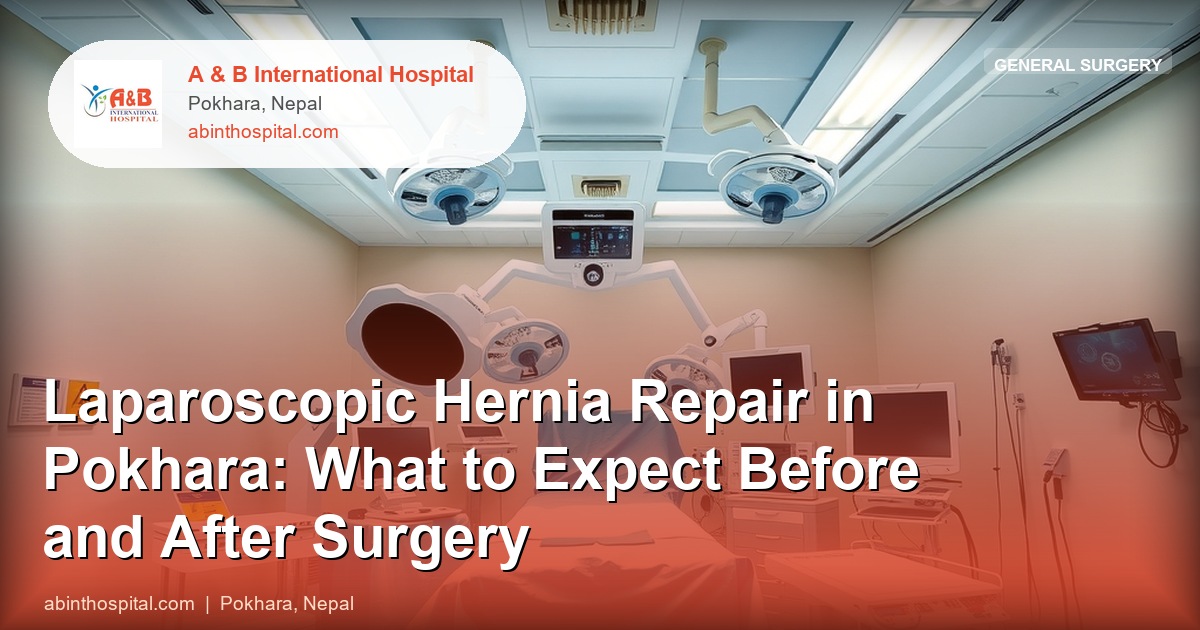
Laparoscopic Hernia Repair in Pokhara: What to Expect Before and After Surgery
A hernia occurs when an organ or fatty tissue pushes through a weak spot in the surrounding muscle or connective tissue. Hernias do not heal on their own and in most cases require surgical repair. Left untreated, a hernia can enlarge, cause chronic pain, or — in the most dangerous scenario — become strangulated, cutting off blood supply to trapped bowel. This is a surgical emergency.
What Are the Different Types of Hernia?
Hernias are classified by their location. Each type has different characteristics, patient populations, and surgical approaches.
Inguinal hernia is the most common type, accounting for approximately 75% of all hernias. It occurs in the groin where the inguinal canal passes through the abdominal wall. More common in men due to the passage of the spermatic cord through this canal. Presents as a groin bulge that may extend into the scrotum, typically visible on standing or straining, disappearing when lying down.
- Indirect inguinal hernia: Follows the path of the inguinal canal. Most common type. Can occur at any age.
- Direct inguinal hernia: Pushes directly through the posterior wall of the inguinal canal. Typically in older men. Acquired rather than congenital.
Umbilical hernia occurs at the navel. Common in newborns (most close spontaneously by age 4–5), and in adults — particularly in women with multiple pregnancies, overweight individuals, and those with ascites. Adult umbilical hernias require surgical repair as they do not close spontaneously.
Incisional hernia develops at the site of a previous abdominal surgical scar. The scar tissue is weaker than the original abdominal wall. Risk factors include wound infection, obesity, and poor nutritional status at the time of original surgery. Can be large, with wide defects requiring mesh repair.
Hiatal hernia involves the stomach pushing up through the diaphragm opening (hiatus) into the chest. Does not produce an external bulge. Causes gastroesophageal reflux (GERD), heartburn, and regurgitation. Management ranges from medical to surgical (laparoscopic fundoplication).
Femoral hernia is less common, occurring below the inguinal ligament in the femoral canal. More common in women. Higher risk of strangulation than inguinal hernia and should be repaired promptly on diagnosis.
What Are the Symptoms of a Hernia?
The classic presentation is a visible bulge at the hernia site, which may be associated with aching or dragging discomfort. Many hernias are asymptomatic initially and discovered incidentally.
Common symptoms:
- Visible or palpable lump that increases in size on standing, straining, or coughing and reduces or disappears when lying flat
- Dragging or aching discomfort at the hernia site, worsening toward the end of the day
- Sharp pain with heavy lifting
- In inguinal hernia: discomfort radiating into the scrotum or inner thigh
- In umbilical hernia: discomfort when coughing or with physical exertion
Asymptomatic hernias (found on physical examination without symptoms) — the decision to repair depends on the patient’s fitness for surgery, lifestyle demands, and the type and size of the hernia. Watchful waiting is an option for minimally symptomatic inguinal hernias in older patients who are unfit for surgery.
When Does a Hernia Become a Surgical Emergency?
A hernia becomes an emergency when the herniated tissue is trapped — either reducible by pressure (incarcerated) or with its blood supply cut off (strangulated). Strangulated hernia carries the risk of bowel gangrene and perforation within hours.
Emergency signs — go immediately to A&B Hospital:
- Hernia that was previously reducible (could be pushed back) is now fixed and cannot be reduced
- Sudden severe pain at the hernia site
- Tender, hard, red, warm lump
- Nausea, vomiting, or inability to pass stool or flatus (signs of bowel obstruction)
- Fever alongside groin or abdominal pain
Strangulated hernia requires emergency surgery, which carries higher risk than elective repair. This underscores the importance of treating hernias electively once diagnosed.
What Is the Difference Between Laparoscopic and Open Hernia Repair?
Both laparoscopic and open hernia repair achieve effective repair with mesh reinforcement. The approach depends on hernia type, size, patient anatomy, and surgical preference.
Laparoscopic hernia repair (TEP — Totally Extraperitoneal or TAPP — Transabdominal Preperitoneal):
- 3 small port incisions (0.5–1.2 cm)
- Mesh placed behind the abdominal wall, covering the hernia defect
- Advantages: less post-operative pain, faster return to work, better cosmesis, bilateral hernias repaired through same ports
- Requires general anesthesia
- Preferred for bilateral inguinal hernias and recurrent hernias
Open hernia repair (Lichtenstein tension-free mesh technique):
- Single incision in the groin
- Mesh sutured over the hernia defect
- Can be performed under spinal or local anesthesia
- Well-established, durable technique with over 40 years of evidence
- Preferred for very large, complicated, or incarcerated hernias
What Mesh Is Used in Hernia Repair and Is It Safe?
Polypropylene mesh is the standard material used in hernia repair. It is well-tolerated, biocompatible, and integrates with surrounding tissue over 3–4 months. The mesh acts as a scaffold that permanently reinforces the abdominal wall.
Mesh safety: Serious mesh complications are uncommon. The principal risks — infection, mesh migration, and chronic pain — are reduced by correct surgical technique and mesh selection. The benefits of mesh repair — significantly lower hernia recurrence rate (1–3% with mesh versus 10–15% without) — outweigh these risks in the vast majority of patients.
What Post-Operative Care Is Needed After Hernia Surgery?
Days 1–3: Rest at home. Oral analgesia (paracetamol and ibuprofen). Light walking encouraged. Avoid straining, heavy lifting, and constipation (straining increases pressure on the repair). Stool softener if needed.
Week 1–2: Increase walking gradually. No lifting over 5 kg. Return to sedentary work typically at 5–7 days for laparoscopic repair, 10–14 days for open.
Week 4–6: Return to moderate physical activity. Avoid heavy lifting until 6 weeks.
Week 6 and beyond: Full return to manual work and heavy physical labor. No permanent activity restrictions following complete healing.
Scrotal swelling and bruising after inguinal hernia repair is common and alarming-looking but usually resolves within 2–3 weeks without intervention.
What Is the Risk of Hernia Recurrence After Surgery?
Recurrence rates with modern mesh repair are low:
- Laparoscopic inguinal hernia repair: 1–2% at 5 years
- Open mesh (Lichtenstein) repair: 2–3% at 5 years
- Repair without mesh: 10–15% — not recommended for adults
Recurrence is increased by obesity, smoking (impairs tissue healing), post-operative wound infection, and premature return to heavy physical activity before the repair has fully healed.
Preventing recurrence:
- Avoid heavy lifting for 6 weeks after surgery
- Maintain a healthy weight
- Treat chronic cough and constipation
- Stop smoking before and after surgery — smoking impairs wound healing
Is Hernia Repair Covered by ECHS at A&B?
Yes. Hernia repair is covered under ECHS for eligible ex-servicemen and their dependants. Both laparoscopic and open repair are covered where medically indicated. Implant costs (mesh) may have partial coverage limits — confirm with the ECHS desk at A&B before surgery.
Hernia Surgery at A&B International Hospital, Pokhara
A&B International Hospital
Pokhara-02, Bindhyaabasini Way to Sarangkot
Phone: +977 061-412512
Website: abinthospital.com
Laparoscopic and open hernia repair. Emergency strangulation surgery available 24/7. ECHS empanelled. Do not wait until your hernia becomes an emergency — book a surgical consultation today.