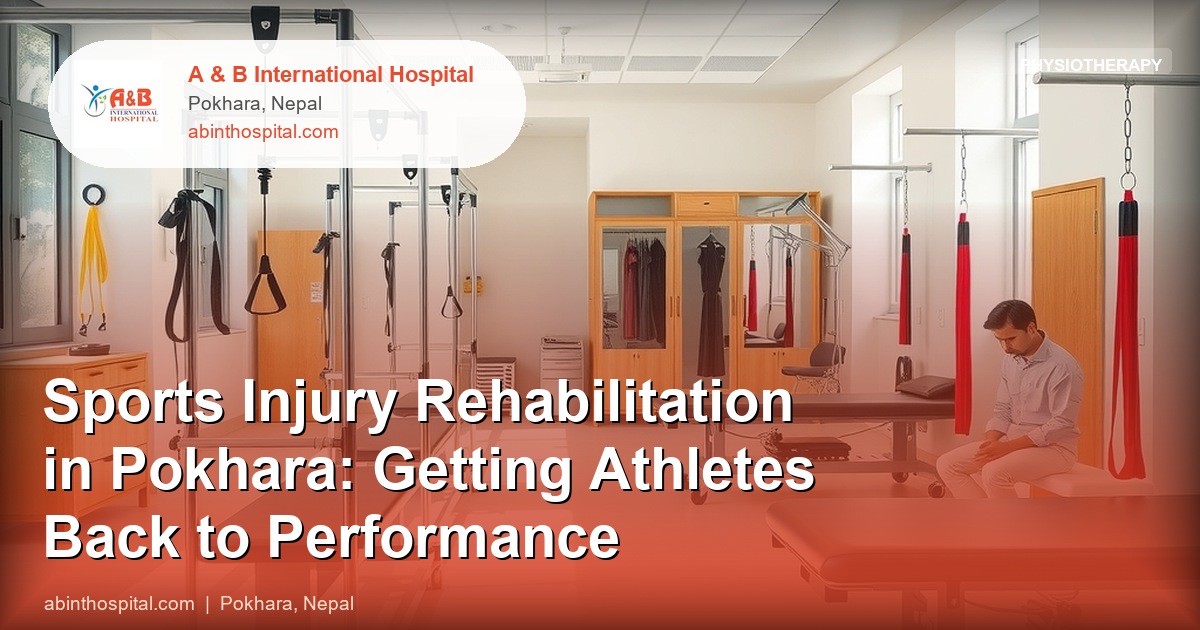
Sports Injury Rehabilitation in Pokhara: Getting Athletes Back to Performance
Pokhara is Nepal’s adventure sports capital. Paragliding from Sarangkot, trekking to Annapurna Base Camp, mountain biking, kayaking on Phewa Lake, and trail running attract athletes from Nepal and around the world. The sports injury burden in this city is high, and the standard of rehabilitation available directly determines whether an athlete returns to full performance or carries a residual vulnerability into their next season.
What Are the Principles of Sports Injury Rehabilitation?
Modern sports rehabilitation has moved beyond the traditional RICE protocol (Rest, Ice, Compression, Elevation) to the POLICE framework: Protection, Optimal Loading, Ice, Compression, Elevation. The key shift is from “rest” to “optimal loading” — a recognition that complete rest delays healing and leads to deconditioning, while appropriate early loading stimulates tissue repair.
Protection means avoiding movements and loads that stress the damaged structure harmfully — not complete immobility. Optimal loading means beginning graded exercise early, at a level that promotes healing without re-injury. The physiotherapist determines what is appropriate based on tissue type, severity, and healing stage.
The principle underlying successful sports rehabilitation is that tissue heals in response to the loads placed on it during healing. Tendons, ligaments, and muscles all remodel to the stresses they experience. Controlled progressive loading during rehabilitation produces a healed structure that is stronger and more resilient than one that healed with rest.
What Are the Phases of Return to Sport After Injury?
Return-to-sport rehabilitation is not a single milestone — it is a staged, criteria-based process. Moving too quickly to the next phase before meeting objective criteria is the primary cause of re-injury.
Phase 1 (acute, typically days 0–5) focuses on pain and swelling control, protecting the damaged structure, and maintaining cardiovascular fitness through non-weight-bearing alternatives (swimming, cycling if tolerated).
Phase 2 (subacute, weeks 2–6 depending on injury) introduces progressive range of motion restoration, early strengthening, proprioceptive retraining on stable surfaces, and continuation of cardiovascular training.
Phase 3 (functional rehabilitation, weeks 4–12+) progresses to sport-specific movements, strength loading matching requirements of the sport, dynamic balance and agility work, and neuromuscular control under fatigue.
Phase 4 (return to sport) begins with modified training (reduced intensity, volume, or contact), then full training, then competition. Each step requires the athlete to meet objective criteria — strength symmetry, functional tests, psychological readiness — before advancing.
What Is the ACL Rehabilitation Protocol?
ACL (anterior cruciate ligament) rupture is one of the most significant sports injuries in terms of rehabilitation length and complexity. It requires 9–12 months of structured rehabilitation before return to cutting, pivoting, and contact sports. Returning earlier significantly increases re-injury risk.
After ACL reconstruction surgery, the graft goes through a process called ligamentisation — the graft tissue transforms from the donor tissue to something that resembles the original ACL. During this process, which takes months, the graft is structurally vulnerable. This is why the return-to-sport timeline for ACL is not determined by how the knee feels but by graft maturation and functional criteria.
Phase 1 (0–6 weeks): Regain full knee extension, reduce swelling, activate quadriceps, walk without a limp.
Phase 2 (6–12 weeks): Achieve 90%+ quadriceps strength symmetry, normalise gait, begin running if criteria met.
Phase 3 (3–6 months): Sport-specific conditioning, strength symmetry testing, single-leg functional assessments.
Phase 4 (6–9 months): High-load sport-specific drills, cutting, landing mechanics.
Phase 5 (9–12 months): Return to sport based on meeting all objective criteria, not time alone.
ACL rehabilitation at A&B is guided by a physiotherapist with sports rehabilitation training, using isokinetic strength testing where available to objectively measure limb symmetry index before return to sport.
How Is Hamstring Strain Rehabilitated?
Hamstring strains are graded 1 (minor), 2 (partial tear), and 3 (complete rupture). Most hamstring strains are grade 1 or 2, recovering in 2–8 weeks with appropriate management.
The key to hamstring rehabilitation is eccentric strengthening — exercises where the hamstring contracts while lengthening. The Nordic hamstring curl is the most evidence-based exercise for both rehabilitation and prevention of hamstring re-injury. Return-to-sprint criterion should include completing the full Nordic protocol without pain and achieving near-symmetry with the uninjured side.
Premature return to full-speed sprinting is the most common cause of hamstring re-injury. Athletes who “feel fine” at low speed may still have a healed but insufficiently conditioned muscle that tears again under sprint loading.
What Does Shoulder Rehabilitation After Dislocation Involve?
First-time shoulder dislocation in a young athlete carries approximately 60–90% recurrence risk without rehabilitation, because the initial dislocation damages the anterior capsule-labrum complex (Bankart lesion). Physiotherapy-based rehabilitation reduces this risk by restoring rotator cuff and scapular stabiliser strength and neuromuscular control.
Post-reduction protocol: 2–3 weeks of sling immobilisation, then progressive range of motion, then rotator cuff strengthening (external rotation with resistance band), scapular strengthening (rows, retraction exercises), and sport-specific overhead training. Full return to contact sport takes 4–6 months.
For athletes with recurrent instability despite rehabilitation, surgical stabilisation (Bankart repair or Latarjet procedure) followed by a structured rehabilitation programme is recommended.
What Injury Prevention Programmes Are Used in Sports Physiotherapy?
Injury prevention is the highest-value intervention in sports medicine — preventing injury is more effective than rehabilitating it. FIFA 11+ is the most evidence-based programme for reducing lower limb injury in football players, reducing ACL injuries by up to 50% in studies.
The programme includes warm-up running exercises, strengthening exercises (single-leg balance, Nordic hamstring, Copenhagen adductor), and plyometric progressions. It takes 20 minutes and is performed as a standard warm-up protocol.
For trekkers and trail runners in the Pokhara region, injury prevention focuses on: adequate quad and gluteal strength for descent (the most injury-provoking phase), ankle proprioceptive training for uneven terrain, appropriate footwear, and graded load increases avoiding the 10% per week overload rule violation.
For paragliding athletes, shoulder and rotator cuff conditioning, thoracic mobility, and landing fall training reduce the risk of shoulder and wrist injuries from uncontrolled landings.
A&B International Hospital
Pokhara-02, Bindhyaabasini Way to Sarangkot
Phone: +977 061-412512
Website: abinthospital.com
For sports injuries in Pokhara — whether you are a local athlete, a trekker, or an adventure sports participant — A&B International Hospital’s sports physiotherapy team provides evidence-based diagnosis, rehabilitation, and return-to-sport management. ECHS polycards accepted.