
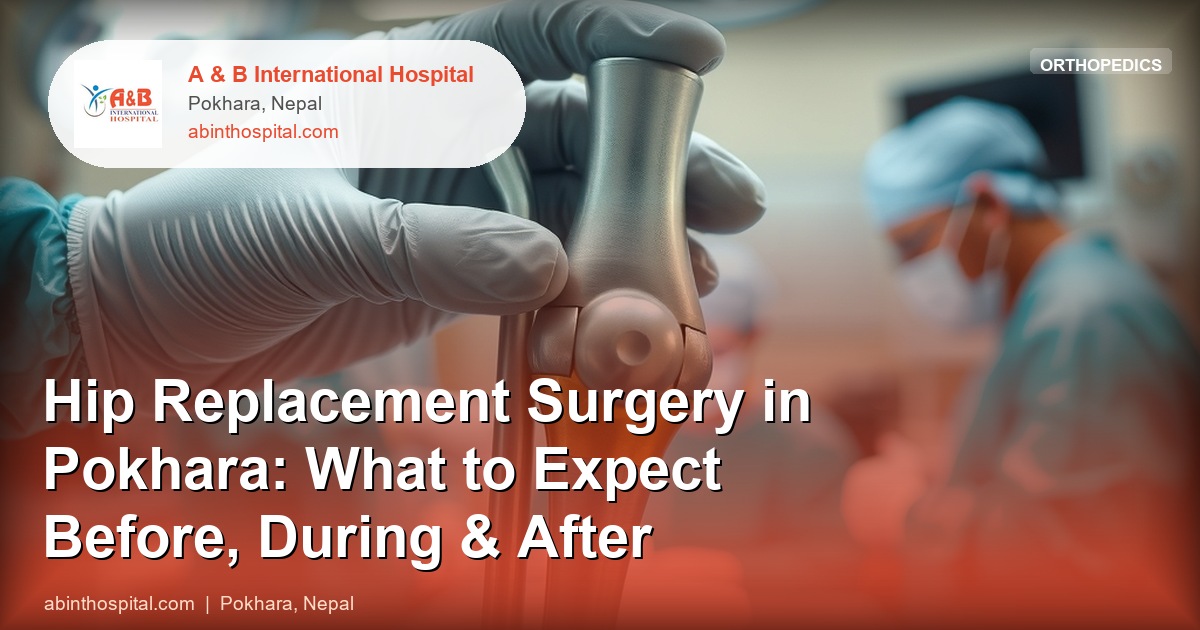
Hip Replacement Surgery in Pokhara: What to Expect Before, During & After
Hip joint failure is one of the most debilitating orthopedic conditions — it makes walking painful, disrupts sleep, and eliminates the daily routines most people take for granted. When the hip joint deteriorates beyond repair, hip replacement surgery restores function, eliminates pain, and returns patients to independent, active living.
A&B International Hospital in Pokhara performs both total and partial hip replacement surgery using American orthopedic implants and instruments. For patients in the Gandaki Province, this means specialist orthopedic surgery is now available locally — with ECHS cashless coverage for eligible ex-servicemen and their dependents.
What Is the Difference Between Total and Partial Hip Replacement?
Total hip replacement (THR) replaces both the ball (femoral head) and the socket (acetabulum) of the hip joint. Partial hip replacement (hemiarthroplasty) replaces only the femoral head, leaving the natural socket intact. The right choice depends on diagnosis, bone quality, and the patient’s age and activity level.
Total hip replacement is most commonly performed for osteoarthritis, rheumatoid arthritis, and avascular necrosis where both joint surfaces are damaged. It provides longer-lasting pain relief and is the standard for most elective hip replacement patients.
Partial hip replacement (hemiarthroplasty) is typically reserved for:
- Femoral neck fractures in older patients where speed of surgery and simplicity of recovery are prioritized
- Cases where the acetabular (socket) cartilage remains intact
In most planned (elective) hip replacement cases, total hip replacement is the procedure of choice.
Who Needs Hip Replacement Surgery?
Hip replacement is indicated when hip joint damage is severe enough to cause constant pain and significant functional limitation that has not responded adequately to conservative treatment over at least three to six months.
Common causes requiring hip replacement:
- Osteoarthritis — the most common indication; cartilage loss leads to bone-on-bone friction
- Rheumatoid arthritis — autoimmune destruction of the hip joint
- Avascular necrosis (AVN) — poor blood supply causes the femoral head to collapse; seen in patients with steroid use, alcohol use, sickle cell disease, or previous hip fracture
- Post-traumatic arthritis — arthritis following old acetabular fractures
- Hip dysplasia — abnormal hip development causing early-onset joint failure
Patients are typically adults over 50, though younger patients with AVN or post-traumatic arthritis may require hip replacement earlier. The decision is individualized — based on pain severity, X-ray findings, functional limitation, and overall health status.
What Implant Types Are Used at A&B for Hip Replacement?
A&B International Hospital uses American-standard hip implants, with fixation method selected based on patient age, bone density, and activity level. The two main fixation approaches are cemented and cementless.
Cemented fixation: The implant is secured to bone using bone cement (polymethylmethacrylate, PMMA). This provides immediate stability and is preferred in older patients with softer bone (osteoporosis) where cementless ingrowth may be inadequate.
Cementless fixation: The implant has a porous or textured surface that allows bone to grow directly into it over 6–12 weeks. This is preferred in younger, more active patients with good bone quality because it avoids cement interface complications over time.
Hybrid fixation: A cemented stem combined with a cementless acetabular cup — a combination used in selected patients.
The bearing surface (what moves against what) is another critical choice:
- Metal-on-polyethylene — most commonly used; reliable long-term wear profile
- Ceramic-on-polyethylene or ceramic-on-ceramic — lower wear rates, used in younger patients
American-standard implants at A&B use high-grade materials engineered for the precise fit required to achieve long implant survival. Implant choice is discussed with each patient prior to surgery.
What Happens During the Hip Replacement Procedure?
Hip replacement surgery at A&B is performed under spinal or general anesthesia and takes approximately 1.5 to 2.5 hours. The surgical approach — the direction from which the surgeon enters the hip — affects recovery, and A&B’s orthopedic team selects the approach most suited to each patient’s anatomy.
Procedure sequence:
- Anesthesia — spinal or general, with the choice made after assessment
- Positioning — patient placed on their side or back depending on surgical approach
- Incision and tissue dissection — access to the hip joint
- Dislocation of the femoral head — the damaged ball is removed
- Acetabular preparation — the socket is reamed to the correct size and the acetabular cup is fixed
- Femoral preparation — the femoral canal is prepared and the stem is inserted
- Reduction and testing — the new joint is assembled and tested for stability and leg length equality
- Closure — tissues are sutured in layers; a drain may be placed
What Is the Recovery Timeline After Hip Replacement?
Recovery from total hip replacement follows a structured progression. Most patients are walking with a frame the day after surgery and are discharged within 3–5 days.
Recovery timeline:
| Timeframe | Expected Progress |
|---|---|
| Day 1 | Sitting up, dangling legs, physiotherapy begins |
| Day 2–3 | Standing with frame, first steps |
| Day 3–5 | Discharge home in most uncomplicated cases |
| Weeks 2–4 | Walking with a cane indoors, wound check, suture removal |
| Weeks 6–8 | Most patients walking without aids on flat ground |
| Months 3–4 | Return to driving (right hip: 6–8 weeks; left hip: earlier for automatics) |
| Month 6 | Return to light activities, cycling, community walks |
| Year 1 | Full recovery; implant fully integrated |
Hip precautions — avoiding deep bending of the hip beyond 90 degrees, crossing legs, or turning the foot inward — must be followed for the first 6–12 weeks to prevent dislocation. The physiotherapy team at A&B teaches these precautions before discharge.
When Can a Patient Walk and Drive Again After Hip Replacement?
Most patients walk with a walker or frame the day after surgery. Progression to a cane typically occurs by weeks 2–3, and unaided walking on flat surfaces is usually achieved by weeks 6–8, depending on the individual’s recovery rate.
Driving timelines depend on which hip was operated and vehicle type:
- Left hip (automatic vehicle): typically 4–6 weeks
- Right hip (any vehicle): typically 6–8 weeks, once reflex braking response is fully restored
A formal return-to-driving assessment is recommended before resuming driving. Patients should not drive while using opioid pain medications.
What Does Hip Replacement Surgery Cost in Pokhara?
Hip replacement at A&B International Hospital is priced competitively — considerably below Kathmandu private hospitals and Indian hospitals when travel and accommodation costs are included. The package includes pre-operative assessment, surgery, anesthesia, implant, hospital stay, and initial physiotherapy.
ECHS-empanelled patients receive cashless coverage for hip replacement at A&B. Ex-servicemen and their dependents should bring their ECHS card and complete their pre-authorization process. The A&B administrative team assists with documentation.
For current pricing, contact A&B directly at +977 061-412512.
When Should Hip Replacement Surgery NOT Be Done?
Hip replacement is contraindicated or should be deferred in certain clinical situations:
- Active infection anywhere in the body (dental, urinary, skin) — must be treated before surgery to prevent joint implant infection
- Severe cardiac or pulmonary disease where anesthesia risk is unacceptably high
- Uncontrolled diabetes — impairs wound healing and increases infection risk
- Morbid obesity — significantly increases complication rates; weight loss may be recommended first
- Insufficient bone stock — rare anatomical situations where implant fixation is not possible
- Patient unable to comply with post-operative restrictions — cognitive impairment or behavioral factors that prevent hip precaution adherence
The orthopedic team at A&B conducts a full preoperative assessment to identify and address these factors before planning surgery.
Book Your Hip Replacement Consultation at A&B International Hospital
If hip pain has taken away your independence, your sleep, or your ability to move freely — a consultation with A&B’s orthopedic team is the next step. We perform hip replacement surgery in Pokhara using American implants and instrumentation, with a structured recovery program from day one.
A&B International Hospital
Pokhara-02, Bindhyaabasini
Phone: +977 061-412512
Website: abinthospital.com
ECHS-eligible patients receive cashless coverage. Emergency orthopedic care is available 24 hours a day.