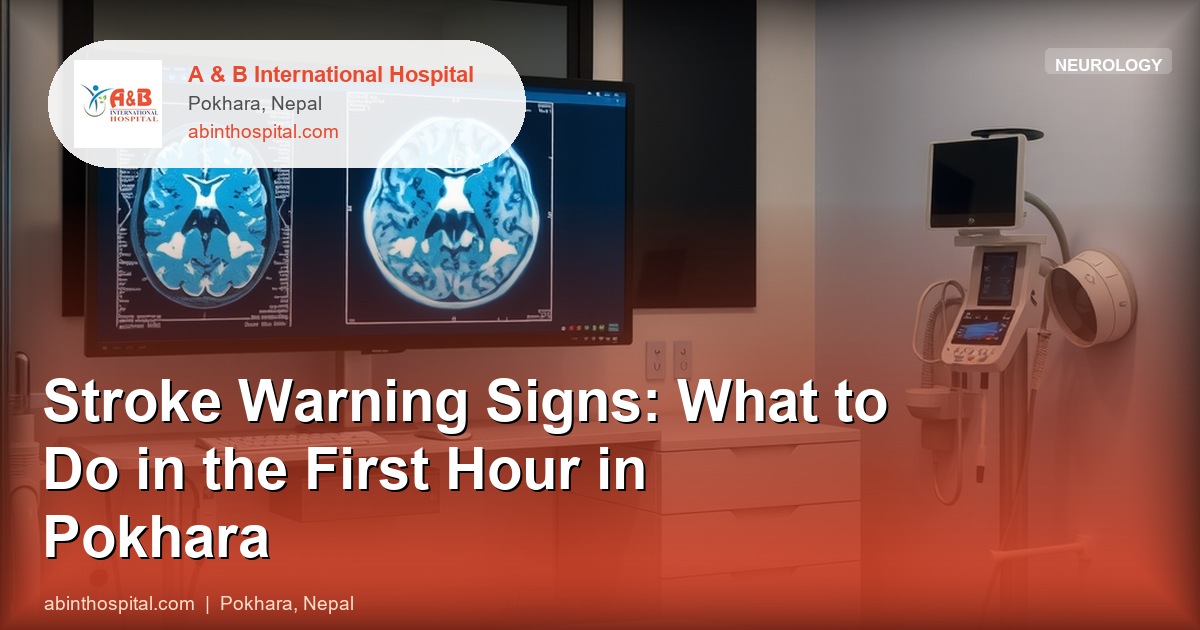
Stroke Warning Signs: What to Do in the First Hour in Pokhara
Stroke is Nepal’s leading cause of death and disability among adults over 40. In Pokhara, as across much of Nepal, delayed presentation to hospital remains the single biggest barrier to good outcomes. The difference between walking out of hospital and permanent paralysis often comes down to whether a bystander recognised the warning signs and acted within the first sixty minutes.
What Does FAST Stand For and Why Does It Matter in Stroke?
FAST is a four-item checklist: Face drooping (one side of the face falls when the person smiles), Arm weakness (one arm drifts down when both are raised), Speech difficulty (slurred or absent speech), Time to call emergency services. Recognising any one of these signs means calling for help and reaching hospital immediately.
The FAST acronym was developed to give non-medical bystanders a reliable way to identify the most common stroke presentations. In Nepal, where awareness of stroke as a time-sensitive emergency has historically been low, FAST provides an actionable framework that does not require medical training.
Face drooping is best tested by asking the person to smile or show their teeth. Asymmetry — one side not moving — is a positive sign. Arm weakness is tested by asking the person to raise both arms to shoulder height with eyes closed for ten seconds. If one arm drifts down or cannot be raised at all, that is a positive finding. Speech difficulty includes any combination of slurred speech, inability to find words, or complete inability to speak.
When any of these signs are present, time has already been lost. The correct response is immediate transport to hospital, not waiting to see whether symptoms improve.
What Are the Other Warning Signs of Stroke Beyond FAST?
Beyond the three FAST signs, stroke can also present with sudden loss of vision in one or both eyes, a severe headache described as the worst of the person’s life, sudden confusion or difficulty understanding speech, and loss of balance or coordination. Any sudden neurological symptom — one that appears within seconds to minutes — should be treated as a stroke until proven otherwise.
Sudden loss of vision in one eye (amaurosis fugax) can represent a transient ischaemic attack (TIA) — sometimes called a mini-stroke — affecting the retinal artery. TIAs resolve within 24 hours but carry a significant risk of full stroke within the following days. A patient who has had a TIA needs urgent evaluation, not reassurance that they have recovered.
The severe headache — often described as a thunderclap or as if the head has been struck — is the hallmark of subarachnoid haemorrhage, a type of bleeding stroke caused by rupture of a cerebral aneurysm. This is a neurosurgical emergency with very high mortality if untreated.
What Is the Difference Between Ischemic and Hemorrhagic Stroke?
Ischemic stroke is caused by a blocked blood vessel cutting off oxygen supply to brain tissue. Hemorrhagic stroke is caused by a ruptured blood vessel bleeding into or around the brain. Ischemic stroke accounts for approximately 85% of all strokes; hemorrhagic stroke is less common but carries higher immediate mortality.
The distinction matters critically for treatment. The main pharmacological treatment for ischemic stroke is thrombolysis — a clot-dissolving drug called alteplase given intravenously. In hemorrhagic stroke, thrombolysis is absolutely contraindicated because it would worsen the bleeding. This is why CT scanning at hospital arrival is not optional — it is the only way to determine which type of stroke has occurred and therefore which treatment is safe.
Patients and families should understand that this distinction cannot be made from symptoms alone. Both types can present with weakness, speech problems, and altered consciousness. CT imaging is the deciding factor, and A&B International Hospital has CT capability available around the clock precisely for this reason.
What Is the Golden Hour and What Happens at A&B Emergency for Stroke?
The golden hour refers to the first 60 minutes after stroke symptom onset, during which thrombolysis for ischemic stroke is most effective. The licensed treatment window extends to 4.5 hours from symptom onset, but outcomes improve significantly the earlier treatment is given. Every 30-minute delay in thrombolysis reduces the likelihood of a good outcome measurably.
When a suspected stroke patient arrives at A&B emergency, the following steps occur in rapid sequence. The patient is assessed using the NIHSS (National Institutes of Health Stroke Scale) to quantify neurological deficit. Blood pressure, blood glucose, and oxygen saturation are measured immediately — high blood glucose and very high blood pressure both worsen stroke outcomes. An urgent CT scan is performed to exclude haemorrhage. Blood tests are drawn to check clotting status, renal function, and full blood count.
If the CT is clear of haemorrhage, the patient is within the treatment window, and there are no contraindications, the thrombolysis decision is made. Following treatment, the patient is admitted for monitoring, cardiac investigation (to identify atrial fibrillation as a cause), and early rehabilitation.
What Are the Main Risk Factors for Stroke in Pokhara?
Hypertension is the single most important modifiable risk factor for stroke and is highly prevalent in Pokhara’s adult population, particularly among ex-servicemen and older adults. Atrial fibrillation — an irregular heart rhythm that promotes clot formation — is the second most important. Diabetes, smoking, obesity, high cholesterol, and previous TIA complete the major risk profile.
In Pokhara specifically, a large proportion of the population with hypertension is either undiagnosed or on treatment that is inconsistently taken. The practice of stopping blood pressure tablets when readings appear normal is a common and dangerous behaviour that significantly increases stroke risk.
How Is Secondary Stroke Prevention Managed at A&B?
After a first stroke or TIA, the priority shifts to preventing a second event. This involves identifying the cause — whether cardioembolism from atrial fibrillation, large artery atherosclerosis, or small vessel disease — and targeting treatment accordingly. Antiplatelet agents (aspirin, clopidogrel) are used for non-cardioembolic ischaemic stroke. Anticoagulation (warfarin or a newer oral anticoagulant) is used when atrial fibrillation is the cause.
Blood pressure must be controlled to a target below 130/80 mmHg. Statin therapy is initiated regardless of baseline cholesterol in ischaemic stroke patients. Lifestyle changes — smoking cessation, dietary modification, increased physical activity — are integral components, not optional additions.
A&B’s neurology team provides structured secondary prevention follow-up as part of its post-stroke care pathway.
A&B International Hospital
Pokhara-02, Bindhyaabasini Way to Sarangkot
Phone: +977 061-412512
Website: abinthospital.com
If you or someone near you develops sudden face drooping, arm weakness, speech difficulty, severe headache, or vision loss — do not wait. Proceed immediately to A&B International Hospital emergency. Stroke treatment is time-critical. ECHS polycards accepted.